
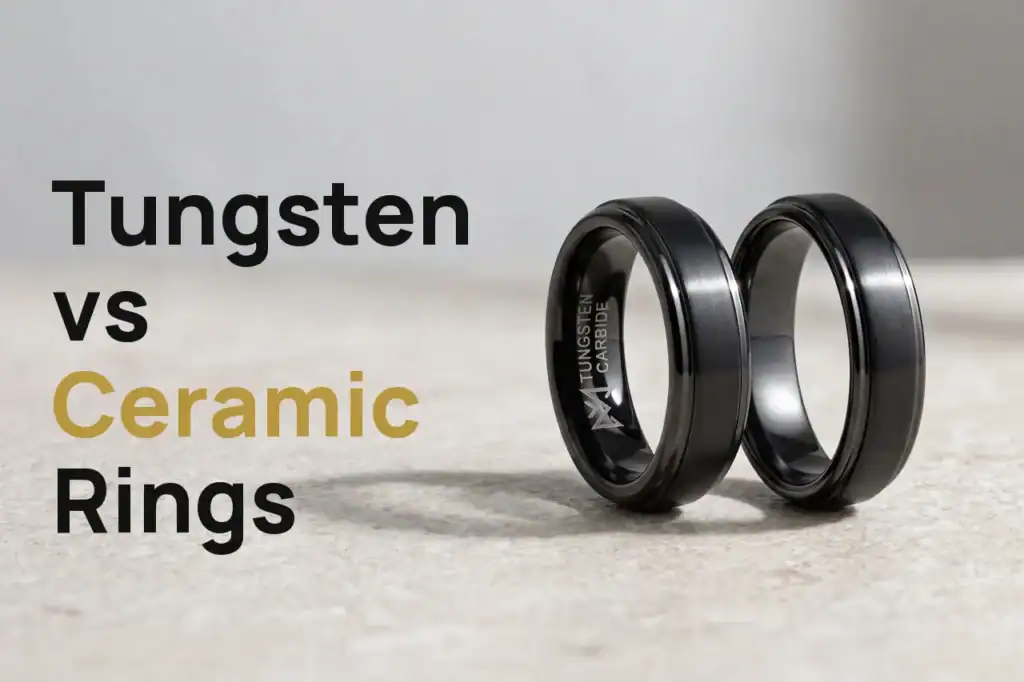
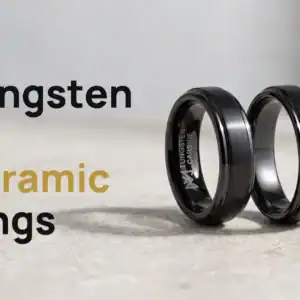
Tungsten vs Ceramic Rings: Are Ceramic Rings Any Good?

Written by Alan MacLachlan, Owner, Newman Bands (Horsham, West Sussex)
Alan has overseen more than 100,000 ring orders since founding Newman Bands with Clare. Newman Bands is the trading name of Manzora Ltd, incorporated in 2001; it has sold men's rings since 2019, with every design and size held in stock in the UK and same-day dispatch on orders before 5pm — most orders arrive within one to two days. Alan personally answers customer queries on metal selection and ring choice every week. Newman Bands has more than 15,000 verified customer reviews — rated 4.99 out of 5 on Reviews.io and 5.0 on Trustpilot.
Yes, ceramic rings are good. Ours weigh about a third as much as our tungsten. Their colour runs all the way through, so there is no black plating to wear off. On zirconia figures, ceramic is nearly as scratch-resistant as tungsten.
The trade-offs are real: ceramic chips more easily than tungsten under a hard knock, and ours only come in black or white.
We sell both from Horsham, West Sussex, and have fulfilled more than 100,000 ring orders. This guide compares the two on weight, scratching, cracking, colour, skin and emergencies, using our own scales and manufacturers’ material data.
Short answer, in Alan’s words: “Ceramic rings are often under estimated, but they are a great option compared to titanium and tungsten rings. It’s just about finding a style you like. The range of ceramic ring styles is limited compared to tungsten and titanium and especially in terms of colours – you only have black or white.”
In this guide
What is a ceramic ring made of?
Watchmaker Rado’s “High-Tech Ceramic” is zirconia (zirconium oxide), and Rado explains how it is coloured. Pigments are blended with the powder before the ceramic is formed. The colour is part of the material, not a coating on top.
Zirconia is the same family of ceramic used for dental crowns and implants. There is an ISO standard for the grade used in surgical implants.
We have not confirmed what our own ceramic rings are made of. So we will not claim ours meets that standard, and the material figures in this guide are for zirconia in general.
Tungsten is mostly ceramic too. A tungsten ring is tungsten carbide: very hard carbide grains held together by a metal binder. Ours are 85% tungsten carbide and 15% nickel. That metal binder is the main reason the two behave differently when dropped.
Tungsten vs ceramic at a glance
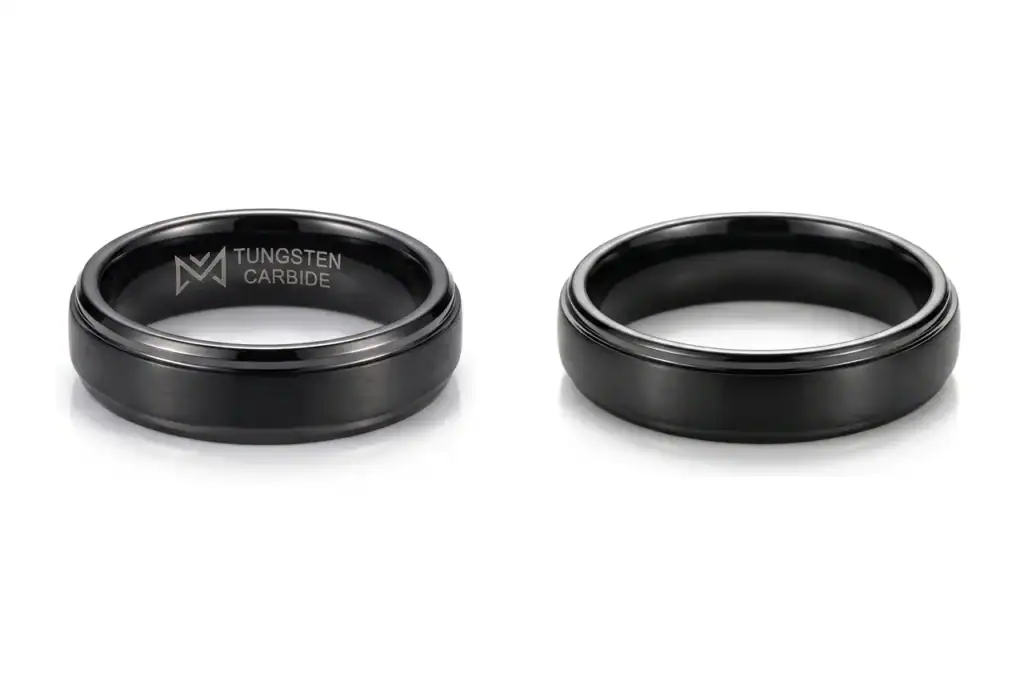
| Tungsten carbide | Ceramic | |
|---|---|---|
| Weight (our 6mm rings, sizes Q to U) | 12 g (the Pursuit) | 4 g (the Esteem) |
| Scratch hardness (Mohs) | 9 | About 8.5 (zirconia) |
| Resistance to cracking | 13.0–14.3 MPa·m½ (two nickel-bound grades, named below) | About 4–8 MPa·m½ (zirconia) |
| Where the colour comes from | Colours such as black and gold are plated over the carbide | Mixed through the material |
| Colours we sell | Silver, black, gold and more | Black or white |
| Conducts electricity | Yes | Zirconia does not |
| Can be resized | No | No |
| Designs in our range | 124 | 4 |
| Price at Newman Bands (7 Oct 2026) | From £53 | From £55 |
The cracking figures are fracture toughness: how well a material stops a small crack from spreading. They come from manufacturers’ datasheets, not from tests on our rings.
The tungsten figures are two nickel-bound grades. ESTECH RCM30 (15% nickel) reads 13.0 and Penn United PUC-12N (12% nickel) reads 14.3. Ours are 85% tungsten carbide and 15% nickel. Sources: ESTECH and Penn United.
Zirconia figures: Kyocera ZO201N and ZO220O. The test methods differ, so read the gap as roughly two to three times.
Which scratches less, tungsten or ceramic?
Tungsten has the edge, but only just. Tungsten carbide sits at 9 on the Mohs scratch scale. GIA puts cubic zirconia, the gem form of the same oxide, at 8.5. Both sit above quartz, which is 7.
Mohs is a ranking, not a ruler. A 9 scratches an 8.5, but the gap tells you little about size. In Vickers hardness, a lab test that presses a diamond point into the surface, both read roughly 1,100–1,300 HV. Rado says its zirconia ceramic is significantly harder than titanium or gold.
In practice, the hardness gap between the two is small. The difference you are more likely to see is on black tungsten, where the plating can scratch. More on that below.
Which is more likely to crack or chip?
Ceramic. This is where tungsten wins. Both are brittle: neither bends like gold or titanium, and a hard enough knock can crack either one. But tungsten’s metal binder makes it roughly two to three times tougher than zirconia on the manufacturers’ figures.
Alan sums it up: “both are very strong but brittle – rare they can chip if dropped, but doesn’t happen often.”
On ceramic specifically, he is candid that the sample is small: “in honesty its hard to say as we don’t sell as many ceramic rings. But i don’t think we have any real issues with them.”
In a 2025 laboratory study, tungsten carbide rings cracked under an average squeeze of 3.7 kN.
That is roughly the weight of 375 kg, yet the rings barely flexed before they cracked. The authors still described the rings as breaking with “a small amount of force”. We know of no equivalent test on ceramic rings.
What this means for you. If your hands take hard knocks on metal or stone every day, tungsten’s extra toughness counts. If you mainly want the look and the lighter feel, ceramic’s lower toughness matters less.
How much lighter is ceramic than tungsten?
About a third of the weight. We put our look-alike pair on the scales, both 6mm, in sizes Q to U. The ceramic Esteem weighed 4 g in each size. The black tungsten Pursuit weighed 12 g in each size.
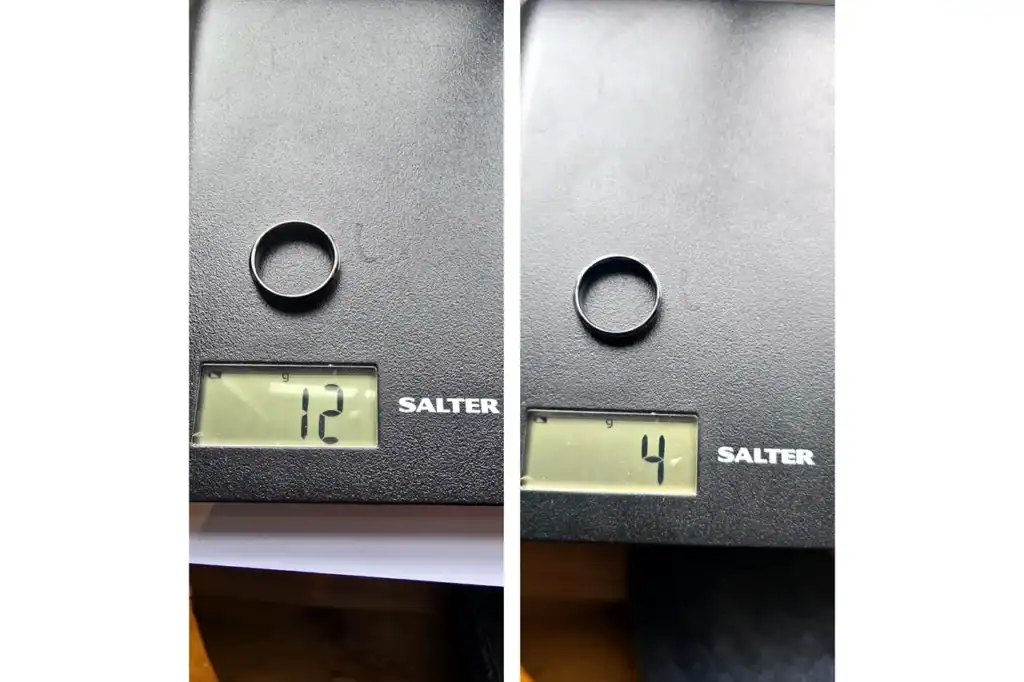
That is lighter than the materials alone predict. Zirconia weighs about 6.0 g per cubic centimetre. A tungsten carbide with a 15% nickel binder weighs about 14.0. So a zirconia ring should weigh around 43% of the same ring in tungsten. Ours came out lighter still, at about a third; our scale reads in whole grams.
Ceramic is not the lightest option, though. Our titanium Resolve, 6mm in size S, weighed 3 g. Grade 5 titanium is about 4.43 g per cubic centimetre, so a zirconia ring is roughly a third heavier than the same ring in titanium.
Weight is a preference, not a flaw. Some men want to forget the ring is there. Others like to feel it on the hand.
Black that stays black: plating vs colour all the way through
This is ceramic’s strongest card. Our black tungsten rings are tungsten carbide with a black PVD plating on top. Our ceramic rings are black, or white, right through.
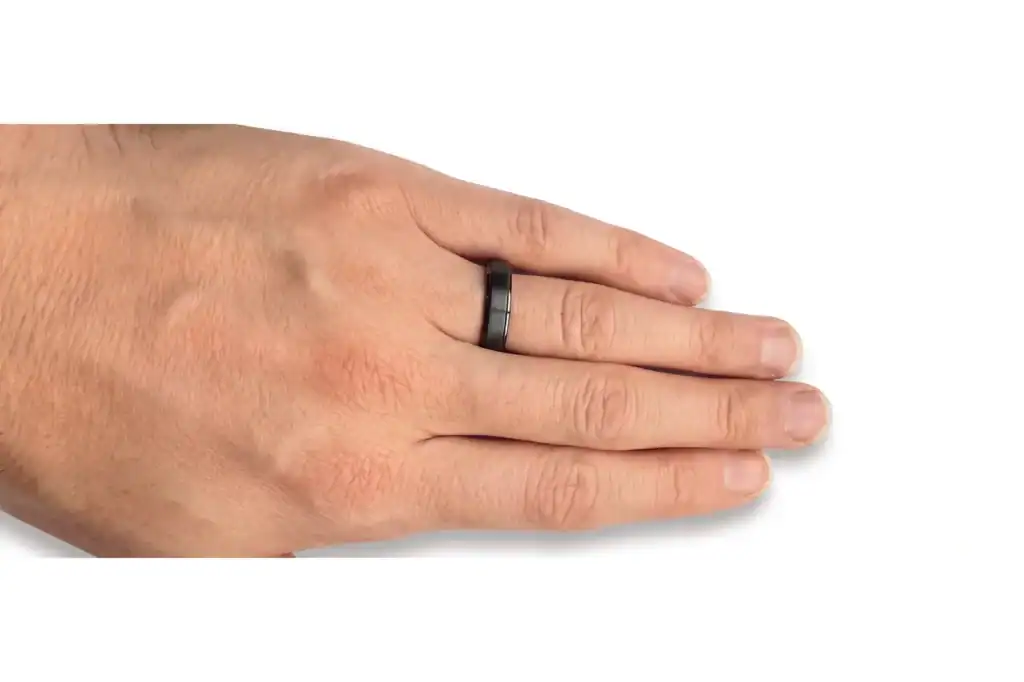
Alan’s experience: “Sometimes the colour fades or scratches on tungsten, not often though. I don’t recall it happening on ceramic.” A deep scratch on black tungsten can show the metal underneath. The same scratch on black ceramic shows more black.
Our team has a stock reply for customers who worry about colour wear. It reads: “You may want to look at the ceramic rings as they have the same colour throughout the ring so show any marks much less than other rings.”
Ceramic is also our only ring that is white right through. The Snow Drift is a polished white 6mm band. Our white-gold-coloured tungsten rings are plated. The flip side: no ceramic option comes in gold, rose gold or a silver tone. For gold or a silver tone, choose tungsten or titanium; for rose gold, tungsten.
Skin, electricity and emergencies
Skin and nickel. Our tungsten contains a nickel binder. In our experience about 1 in 1,000 tungsten buyers react.
Zirconia itself has a long record in dentistry. But black ceramic gets its colour from added pigments, and we hold no specification for ours. So we do not call ceramic “metal-free” or “guaranteed hypoallergenic”.
If you have a diagnosed nickel allergy, our advice is Grade 5 titanium, which is nickel-free by specification. See our guide to the best rings for sensitive skin.
Electricity. Tungsten carbide conducts electricity; zirconia is an electrical insulator (Kyocera datasheet). That is a material fact, not a safety rating. If you work with electricity, follow your employer’s rules on jewellery.
Getting it off in an emergency. Neither ring bends, so neither can be prised open like gold. Emergency-medicine guidance (LITFL) says tungsten carbide and ceramic rings can be cracked off with locking pliers.
In a 2026 study of ring cutters, a purpose-built electric cutter removed every tungsten carbide test ring.
Not every hospital sees these rings often. In a 2016 case report, the emergency doctor lacked experience with tungsten carbide and looked up the method online. If you ever need a ring removed, tell the staff what it is made of.
Resizing. Neither tungsten nor ceramic can be resized. That is why our size exchanges are free and unlimited, as many times as it takes, on any ring that has not been engraved. Every ring also has 100-day free returns, unless it has been engraved.
Why so few people choose ceramic
In Alan’s view, most buyers have never heard of it.
“Everyone has heard or gold and silver and most have heard of tungsten and titanium but only a few know about ceramic.”
Fewer than 1 in 200 of the rings we send out are ceramic.
Choice is the other reason. We have four ceramic designs against 124 in tungsten, all black or white. “They don’t come in as many styles as tungsten so choice is limited. But if you find one you like they are a good option.”
Choose ceramic if you want a black ring with no plating to wear, a white ring, or a lighter feel than tungsten.
Choose tungsten if you want weight on the hand, the widest choice of styles and colours, or the tougher of the two for heavy work.
Our four ceramic rings
- Esteem: black, brushed centre with polished edges, 6mm or 8mm. The ceramic twin of the tungsten Pursuit.
- Panther: brushed black, domed, 4mm, 6mm or 8mm.
- Mountaineer: polished black, domed, 4mm.
- Snow Drift: polished white, 6mm.
All four can be engraved and are held in stock in the UK. Orders placed before 5pm (11am on Saturday) are dispatched the same day.
What Our Customers Say
Every review on our four ceramic product pages is five stars. Three from ceramic buyers:
“The ceramic seems to be less prone to scuffs like the stainless steel. The brushed black gives a slightly gun metal appearance in certain lights. I like that the inside is gloss and feels very comfortable to wear.”
Matt Daly, Portsmouth
verified customer review — quoted word-for-word
“I love how unusual this ring is, how often do you see a white ring. Good quality and comfy to wear.”
Lisa Atkins, Liverpool
verified customer review — quoted word-for-word
“Super light weight and comfortable everyday ring”
Connor Boyd-Scott, Barnsley
verified customer review — quoted word-for-word
Frequently Asked Questions
Are ceramic rings durable?
Yes, with one caveat. On figures for zirconia, ceramic is about 8.5 on the Mohs scale, close to tungsten’s 9, so it is very hard to scratch. Its weak point is a hard knock: it is more brittle than tungsten and can chip if dropped. Alan’s experience is that chips are rare, though we sell fewer ceramic rings.
Do ceramic rings break easily?
More easily than tungsten. Manufacturers’ figures put zirconia’s resistance to cracking at roughly a third to a half of the two nickel-bound tungsten carbide grades in our table. Both are brittle compared with gold or titanium, so neither bends, and a heavy enough blow can crack either.
Is ceramic lighter than tungsten?
Yes, about a third of the weight. Our ceramic Esteem weighed 4 g and the matching tungsten Pursuit 12 g, both 6mm, across sizes Q to U. Titanium is lighter still: our titanium Resolve weighed 3 g at 6mm in size S.
Does black ceramic fade like black tungsten?
Black ceramic has no plating. The colour is mixed into the material, so a scratch shows the same black. Black tungsten is plated, and Alan says the colour sometimes fades or scratches, though not often. He does not recall it happening on ceramic.
Can ceramic rings be resized?
No. Like tungsten and titanium, ceramic cannot be resized. If the size is wrong, we exchange it free, as many times as it takes, as long as it has not been engraved.
Can ceramic rings be engraved?
Yes. All four of our ceramic rings can be engraved. Engraving costs £15, and an engraved ring cannot be returned or exchanged, so check the size first.
Related Guides
Related: are tungsten rings good?
Related: black tungsten rings explained
Related: do tungsten rings scratch?
Compare: tungsten vs titanium rings
Compare: alternative metal wedding rings
Related: the 10 best tungsten rings in the UK
Sizing: men’s ring width guide
Buy Men's Rings
Related guides
Why choose Newmanbands
- 15,000+ verified 5-star reviews
- Free 1-2 day UK delivery
- 100-day free returns
- Every size held in UK stock
- Free ring sizer sent on request
- Personalised engraving