

Silicone Rings for Nurses and Healthcare Workers

Written by Alan MacLachlan, Owner, Newman Bands (Horsham, West Sussex)
Alan has overseen more than 100,000 ring orders since founding Newman Bands with Clare. Newman Bands is the trading name of Manzora Ltd, incorporated in 2001; it has sold men's rings since 2019, with every design and size held in stock in the UK and same-day dispatch on orders before 5pm — most orders arrive within one to two days. Alan personally answers customer queries on metal selection and ring choice every week. Newman Bands has more than 15,000 verified customer reviews — rated 4.99 out of 5 on Reviews.io and 5.0 on Trustpilot.
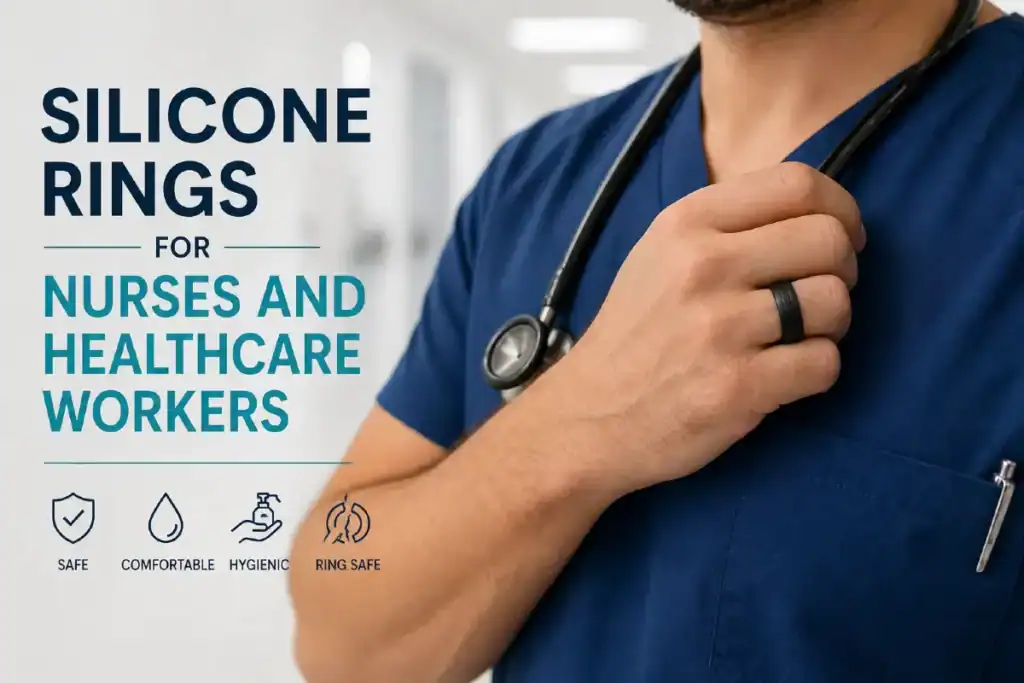
Silicone rings are a practical choice for nurses and healthcare workers who want to wear a ring at work. They are smooth, non-porous on their surface, easy to clean, and flat-profiled — meaning they do not have the raised settings, stones, or crevices that make most metal rings unsuitable for clinical environments.
Newman Bands has fulfilled over 100,000 ring orders from Horsham, West Sussex. Silicone rings are among the products we stock specifically for customers in active and high-risk professions — including healthcare workers who ask us regularly about what ring they can wear at work.
This guide covers NHS ring policies, what makes silicone the safer choice, what to look for when buying, and the honest answer about whether any ring is truly hygienic in a clinical setting.
In this guide
Can Nurses Wear Rings at Work?
It depends on the employer’s policy and clinical setting. Many NHS trusts follow “bare below the elbows” (BBE) guidance, which recommends removing all jewellery including rings before clinical contact. However, a plain, smooth wedding band is sometimes permitted as an exception — and silicone fits this criteria better than most metal rings — and it is easier to keep hygienic too.
Bare below the elbows (BBE): “Bare below the elbows” is NHS hand hygiene guidance recommending that clinical staff remove jewellery and watches below the elbow before patient contact. The guidance is designed to reduce bacterial transmission during hand hygiene. Rings with raised settings, stones, or crevices trap bacteria and make thorough hand-washing more difficult.
Policy varies: NHS trust policies vary by role and department. Theatre and ICU settings apply stricter restrictions than administrative or community roles. Some trusts permit a plain, smooth wedding band as an exception. Always check your specific employer’s current policy document.
Where silicone fits: A silicone ring is typically plain and smooth — no raised settings, no gemstones, no crevices. This is precisely what many NHS exceptions describe. A flat silicone band is more likely to be acceptable under BBE policy than a ridged metal ring or any ring with a stone.
Individual responsibility: This guide provides general information — not clinical or employment advice. If you are uncertain, check with your infection control lead or occupational health department.
Why Silicone Is the Safe Choice for Healthcare Workers
Silicone rings are non-porous on their surface, gemstone-free, and have a smooth profile that is less likely to harbour pathogens than metal rings with settings. They are resistant to most clinical cleaning agents. They sit flush against the finger with no gaps or prongs.
No crevices or settings: The main problem with metal rings in clinical environments is the spaces created by raised settings, stones, and ridged profiles. These spaces trap bacteria, skin cells, and bodily fluids and are difficult to clean during standard hand-washing. A smooth silicone band eliminates these problem areas.
Silicone and gloves: Metal rings — particularly ridged bands — can grip or tear nitrile gloves. A smooth, flat silicone ring is less likely to cause this issue. This matters in environments where glove integrity is important.
Cleaning agents: Silicone is resistant to most clinical cleaning agents and alcohol-based hand rubs. It does not corrode or discolour with normal use. Standard hand sanitiser will not degrade a medical-grade silicone ring under normal usage frequency.
Hypoallergenic: Medical-grade silicone is non-reactive and unlikely to cause skin reactions. This matters in a healthcare environment where skin condition is important.
What to Look for in a Healthcare Ring
A flat or domed profile with no raised edges, stones, or settings. A width of 6mm is typical for a discreet, comfortable option that fits under nitrile gloves. Single-piece silicone construction with no metal inlays.
| Feature | Why It Matters for Healthcare |
|---|---|
| Flat or domed profile | Does not catch on gloves or patients’ skin |
| No stones or settings | Eliminates bacteria-trapping crevices |
| 6mm width | Discreet; fits comfortably under nitrile gloves |
| Single-piece silicone | No components to trap contaminants |
| Neutral colour | Professional appearance in clinical environments |
| No metal inlay | Avoids snag risk on gloves or equipment |
Black is the most popular colour for nurses and healthcare workers — it does not show staining as visibly and maintains a professional appearance. Grey is also widely chosen. Colour is personal preference.
Does Silicone Harbour Bacteria?
Honest answer: all rings — metal or silicone — can harbour bacteria beneath them. Research consistently shows that wearing any ring increases bacterial load on the skin underneath it. The key variable is behaviour: removing and washing the ring, and the skin underneath, as part of your hand hygiene routine.
The science: Studies on ring-wearing in healthcare settings consistently show that any ring increases bacterial counts under it, regardless of material. This is not a flaw unique to metal or silicone — it is a function of wearing any ring. The bacteria accumulate on skin under the ring, not primarily on the ring material itself.
Silicone’s advantage: The smooth, non-porous surface of a silicone ring means bacteria cannot colonise the material as easily as a porous or textured surface. But the skin underneath still needs washing. The practical hygiene behaviour is: remove the ring, wash hands and the skin under the ring, dry thoroughly, replace the ring.
Silicone is easy to remove: Silicone stretches. A correctly sized silicone ring is quick to slip off and back on as part of a hand-washing routine. This practical ease encourages compliance with good hygiene behaviour.
When You Should Remove Your Silicone Ring
Silicone can be cleaned with soap and water, alcohol-based hand sanitiser, and mild disinfectants. It is not suitable for autoclave sterilisation at surgical instrument temperatures — this would damage the silicone. But it can be cleaned to a level appropriate for hand hygiene purposes.
Correct cleaning method: Remove the ring. Clean both the ring and the skin underneath with soap and water for at least 20 seconds. Dry both thoroughly. Replace the ring. This is the standard recommended approach.
Alcohol hand gels: Silicone is resistant to most alcohol-based hand rubs. It will not degrade with normal clinical use frequency. Repeated long-term exposure to very high-concentration alcohol may affect flexibility slightly over time, but this is not a concern under normal conditions.
Avoid autoclave and boiling: Do not autoclave or boil a silicone ring. Neither is necessary for a ring worn on the hand, and the temperatures involved will damage the silicone.
One further note for clinical environments: if a silicone ring is accidentally disposed of in clinical waste, it is not a clinical incident. Silicone is inert, non-toxic, and harmless in clinical waste disposal.
Silicone Rings and NHS Hand Hygiene Policy
NHS England’s “bare below the elbows” guidance recommends removing all hand and wrist jewellery before clinical contact. A plain wedding band is sometimes allowed as an exception under specific trust policies. A silicone ring — being plain and smooth — often qualifies where a ridged metal band would not.
Policy is trust-level, not a single national law. The same principles apply to other healthcare systems: paramedics, care home workers, dental nurses. Check your employer’s current policy document — this guide does not constitute employment or clinical advice.
If in doubt, ask your infection control lead or occupational health department. They are the definitive source for your specific role and setting.
“I work a fairly physical, labour intensive job, so bought this as an accompaniment to my Jet Tungsten ring. It gives me the option of still safely wearing a ring at work without the worry of getting it caught on something. Great quality ring and the two look almost identical at a glance.”
Charlie Knight
verified customer review — quoted word-for-word
Frequently Asked Questions
Can nurses wear wedding rings?
It depends on NHS trust policy and role. Bare-below-the-elbows guidance often restricts rings, but a plain, smooth ring like a silicone band may be permitted as an exception. Check your specific employer’s current infection control policy. A silicone ring’s flat, smooth profile is more likely to meet the criteria where a plain band is permitted than a ridged metal ring or any ring with a setting.
What rings can nurses wear at work?
A plain, smooth, flat band with no stones or raised settings. Silicone is the most widely accepted option in clinical environments because it has no crevices that trap bacteria, does not snag on gloves, and is resistant to standard cleaning agents. Always confirm with your specific employer’s policy.
Are silicone rings hygienic for healthcare?
More hygienic in design than metal rings with settings — silicone has a smooth surface with no crevices. But all rings increase bacterial load on the skin underneath them. Good hand hygiene practice — removing the ring to wash hands thoroughly — is the critical factor, regardless of material.
Do silicone rings harbour bacteria?
Bacteria do not colonise the silicone surface itself as easily as a porous or textured surface. However, bacteria accumulate on the skin under any ring. The key is removing the ring, washing the skin underneath thoroughly, and replacing it. Silicone’s flexibility makes this easy to do during a hand-washing routine.
100-day returns on non-personalised rings. 15,000+ verified reviews.
Related: can you shower with a silicone ring?
Related Guides
Related: the full silicone rings guide
Buy Men's Rings

Related guides



Why choose Newmanbands
- 15,000+ verified 5-star reviews
- Free 1-2 day UK delivery
- 100-day free returns
- Every size held in UK stock
- Free ring sizer sent on request
- Personalised engraving