
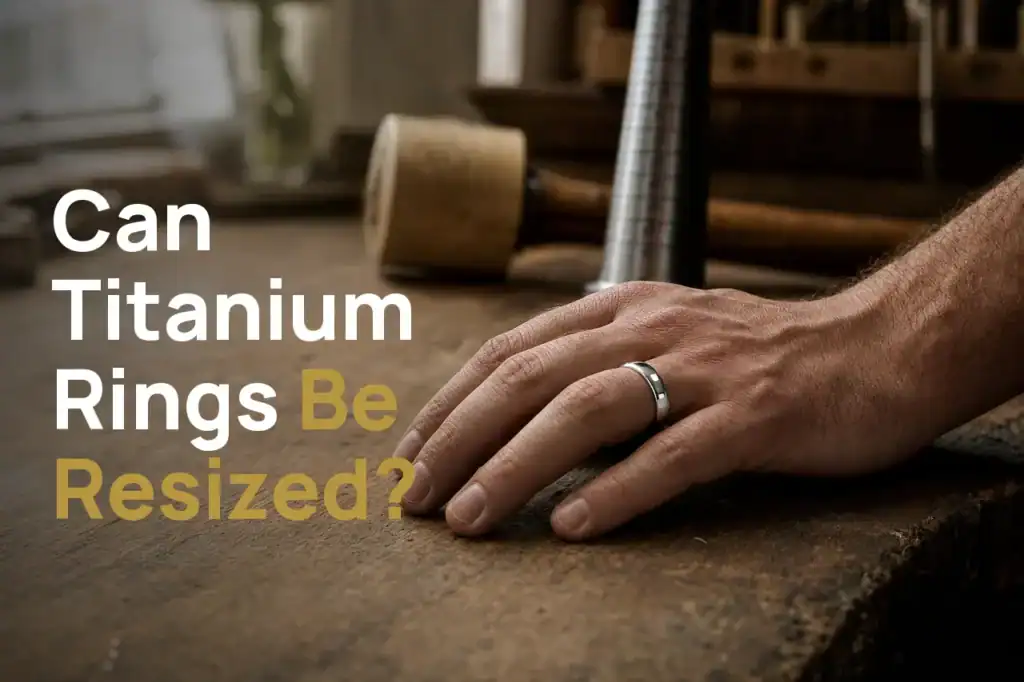
Can Titanium Rings Be Resized?

Written by Alan MacLachlan, Owner, Newman Bands (Horsham, West Sussex)
Alan has overseen more than 100,000 ring orders since founding Newman Bands with Clare. Newman Bands is the trading name of Manzora Ltd, incorporated in 2001; it has sold men's rings since 2019, with every design and size held in stock in the UK and same-day dispatch on orders before 5pm — most orders arrive within one to two days. Alan personally answers customer queries on metal selection and ring choice every week. Newman Bands has more than 15,000 verified customer reviews — rated 4.99 out of 5 on Reviews.io and 5.0 on Trustpilot.
No. A titanium ring cannot be resized the way a gold or silver ring can, and our Grade 5 titanium rings cannot be resized at all. That is why we offer free unlimited size exchanges and 100-day free returns instead. Here is what stops a jeweller, and what to do if your finger changes.
In this guide
Why cut-and-solder does not work on titanium
A jeweller resizes a gold ring by cutting the shank, adding or removing a piece of metal, and soldering the join. The soldering step does not work on titanium, and that breaks the whole method.
Solder cannot join it. Jewellers’ solders melt far below the metal they join. Cooksongold lists 9ct easy solder at 650 to 720 °C. Its 9ct hard solder melts at 755 to 795 °C.
Titanium melts at about 1,670 °C, roughly 900 to 1,000 °C above any of them. Titanium is “very difficult to solder directly”, as its Wikipedia entry puts it.
Heat makes it brittle in air. TWI, the UK welding research body, explains what heat does. Above 400 °C, oxygen and nitrogen diffuse into titanium and embrittle it.
That is why TWI says arc welding titanium is restricted to gas-shielded processes. TIMET’s alloy datasheet says that for most welding methods an inert gas or vacuum environment is required. A bench torch and flux cannot do that.
It is machined from solid bar. Titanium rings are cut from bar on the same equipment used for stainless steel. A maker with a lathe can re-bore one. A jeweller with a torch cannot join it.
So the two things a jeweller relies on, a torch and solder, are useless here. What remains is force: stretching a plain band on a mandrel, or boring metal out of the inside. Whether that works depends on which titanium the ring is made from.
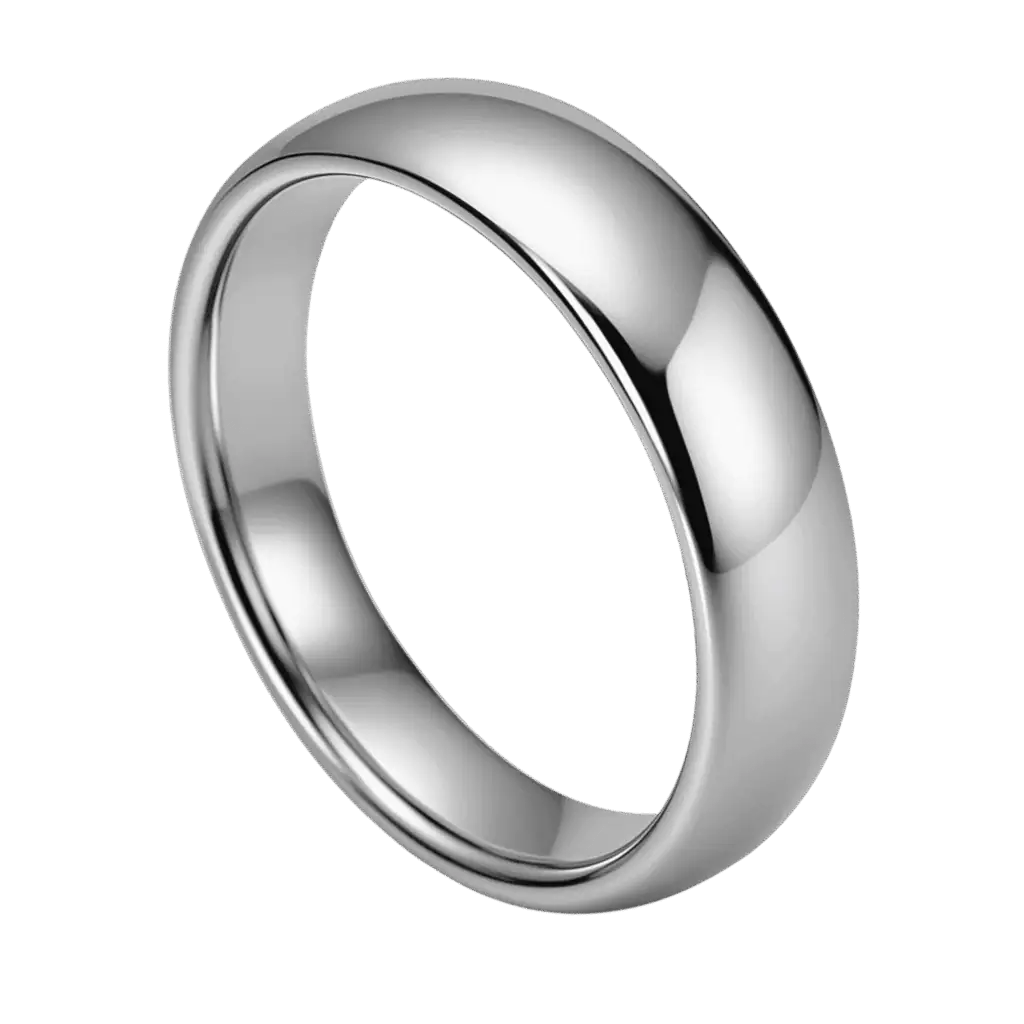
Short answer: titanium cannot be cut and soldered like gold. A few specialist makers will stretch or bore out a plain commercially pure band by a limited amount. Grade 5 alloy will not stretch or compress, and skimming its bore strips a PVD finish. Ours are coated Grade 5, so we exchange the ring for the right size instead.
What specialist makers can and cannot do
Two UK titanium makers, GETi in Birmingham and Love2Have in Herefordshire, say they can stretch or compress their own plain rings. Both say the same two things. It works on commercially pure Grade 2 titanium. It does not work on the aircraft-grade alloy.
That distinction is the whole answer. There are two common kinds of titanium in rings:
- Commercially pure Grade 2. Soft enough to move a limited amount on a ring stretcher. Alleima’s Grade 2 datasheet gives a minimum yield strength of 275 MPa and at least 20% elongation.
- Grade 5, the Ti-6Al-4V alloy. Titanium with 6% aluminium and 4% vanadium. The AZoM datasheet gives a minimum 0.2% proof stress of 828 MPa and 10% elongation. That is roughly three times the strength and half the stretch of Grade 2, and high-strength titanium alloys spring back after forming.
GETi’s own words: Grade 5 “will not stretch or compress”, and the only option is to remachine the bore slightly larger.
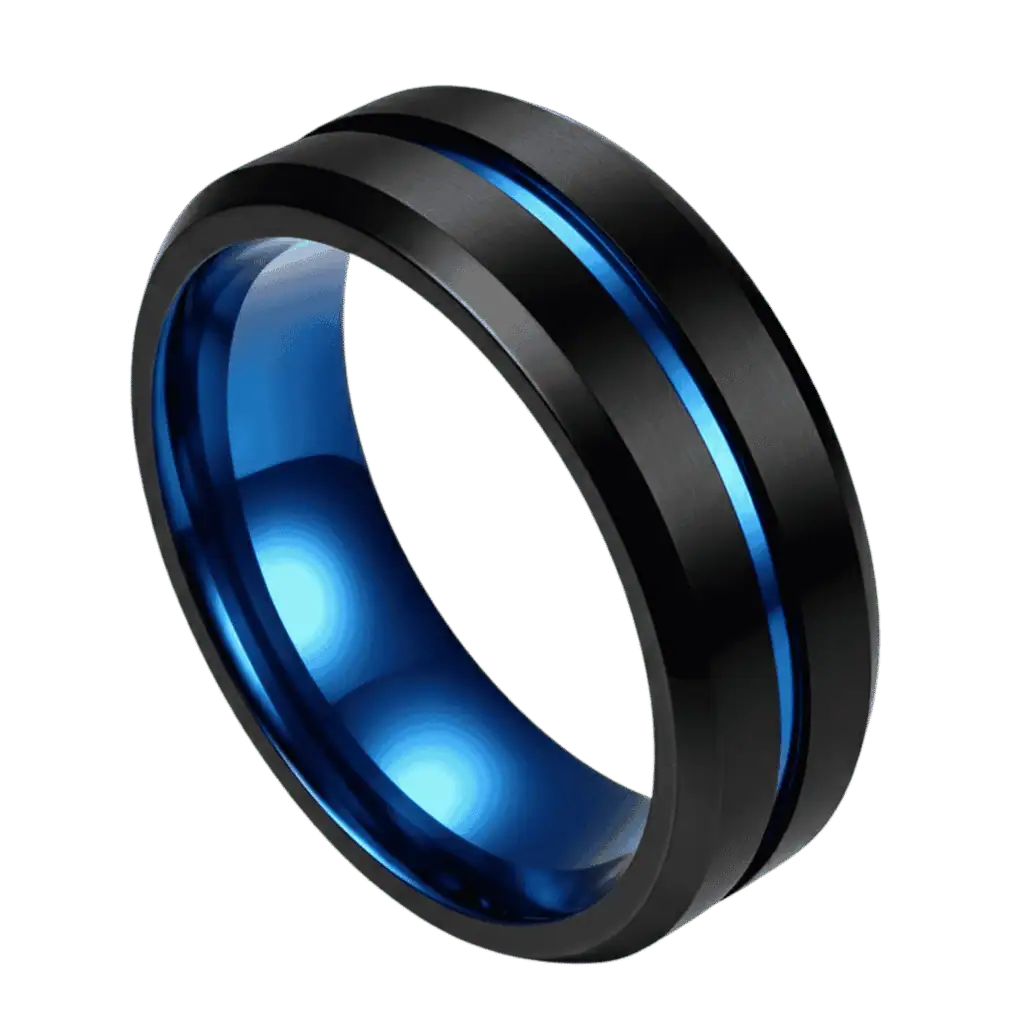
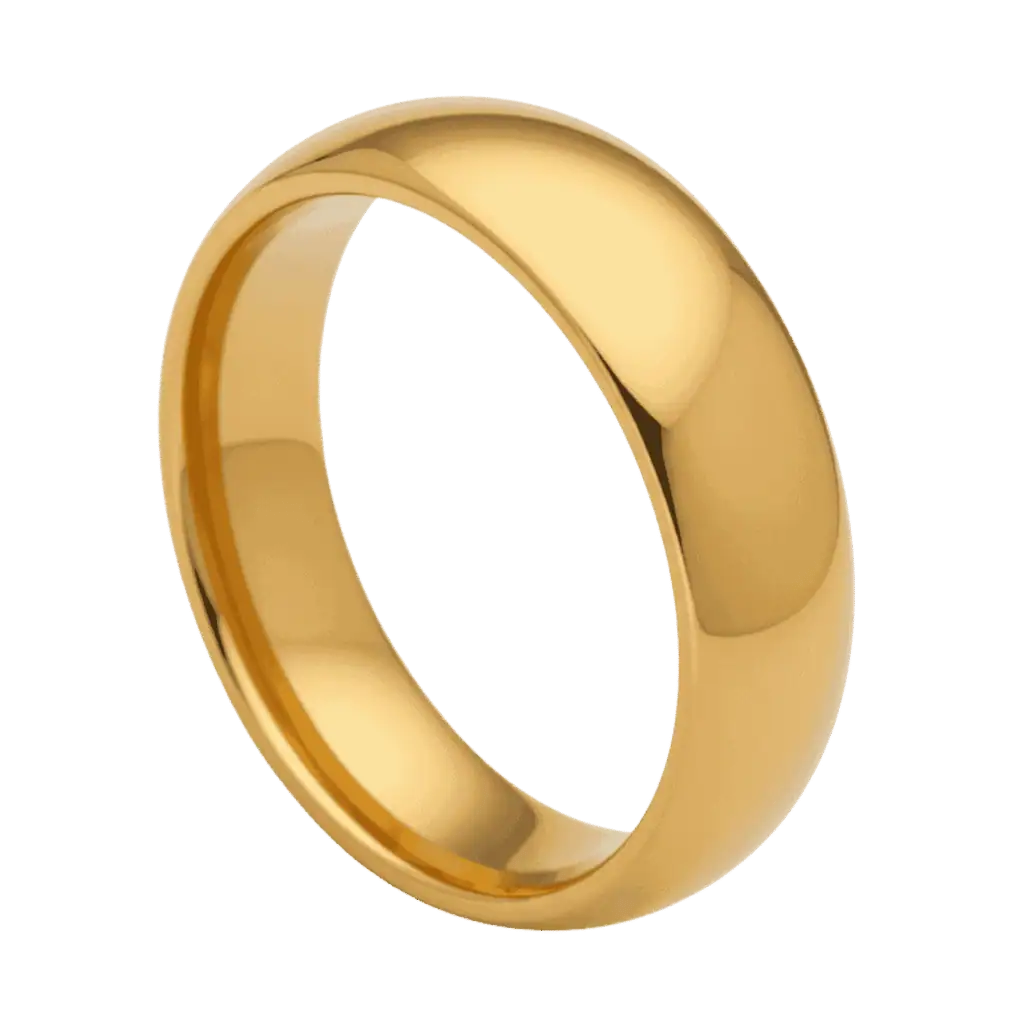
Our titanium rings are Grade 5, in every colour. In Alan’s words, all the rings are plated, none are bare: silver-grey, black, blue and gold-tone are each a PVD finish over the same alloy.
Inlays, stones and patterns limit it further. GETi says stretching normally splits an inlay, so an inlaid ring is bored out to go up. Compressing one down is usually possible, by a small amount. Diamond-set rings are “quite limited” for a similar reason. A patterned ring cannot be compressed without damaging the surface.
Coated rings are the group no route helps. The colour is a surface film, and both stretching and boring work that surface. Thin bands are limited too, because boring out the inside removes wall thickness a slim ring cannot spare.
How much can Grade 2 be moved? We could not find a trade body, a standard or a test that states a figure. The two makers who name the grade give a range, untested.
Four other pages give figures that disagree with each other, and the one that names a grade gets it wrong. So we do not print a number.
Will a high-street jeweller do it? We read the price lists on 14 September 2026. H Samuel lists silver, 9ct, 14ct, 18ct gold and platinum only. Timpson’s ring resizing page does not mention titanium either.
A goldsmith answering the question on Reddit put it simply: you are unlikely to find a jeweller to resize it. One London repairer does list “most stainless/titanium bands” for resizing, with no grade stated and no word on coated rings.
Our rings: every Newman Bands titanium ring is Grade 5 with a PVD finish, so it cannot be resized. No UK chain we checked offers titanium resizing. If the size is wrong, we exchange it. If your finger changes years later, a new ring is the answer.
What we do instead: exchange, as many times as it takes
Around three in ten of our customers need a size exchange. That includes people who had their finger measured at a jeweller first. Fingers change size through the day and with the weather, so a measurement taken on a cold morning can be wrong by a warm evening.
Here is how an exchange runs, in Alan’s words:
“Exchanges are dealt with the day they arrive and sent back using Royal Mail Tracked 48, so the whole process can take three to four days. Sometimes a little longer depending on how long it takes the ring to arrive back to us. It’s sent freepost, so you don’t have to pay for the return.”
The policy is free and unlimited. We exchange for a different size as many times as it takes, with no limit and no catch. Alongside it, every unengraved ring has 100-day free returns.
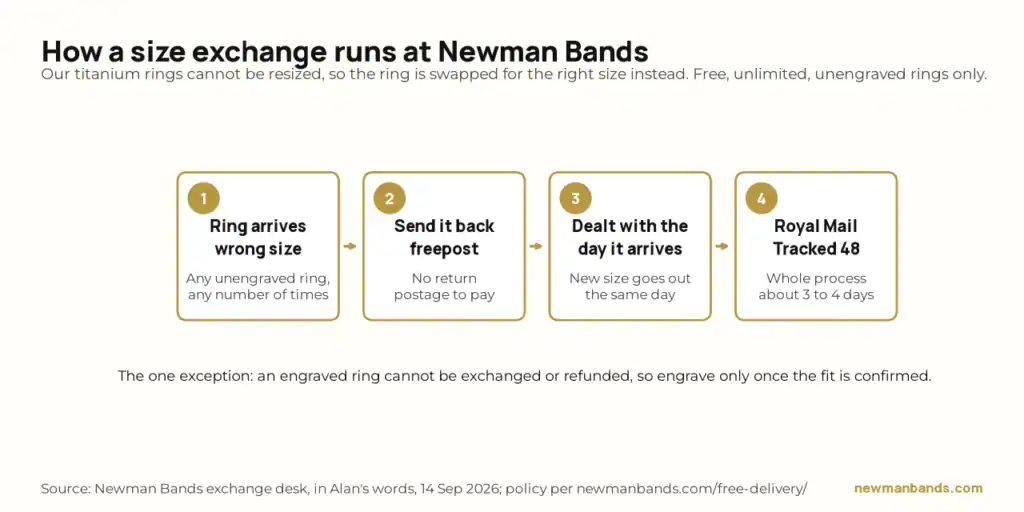
The one exception is engraving. An engraved ring is personalised, so it cannot be exchanged or refunded. That is why engraving is a separate step at Newman Bands. The ring ships plain, you confirm the fit, and then it goes back to us for engraving. Alan’s rule: do not get it engraved until you are sure it fits.
Which way do exchanges go? In our experience it is an even split between too big and too small.
If your finger changes after the 100 days
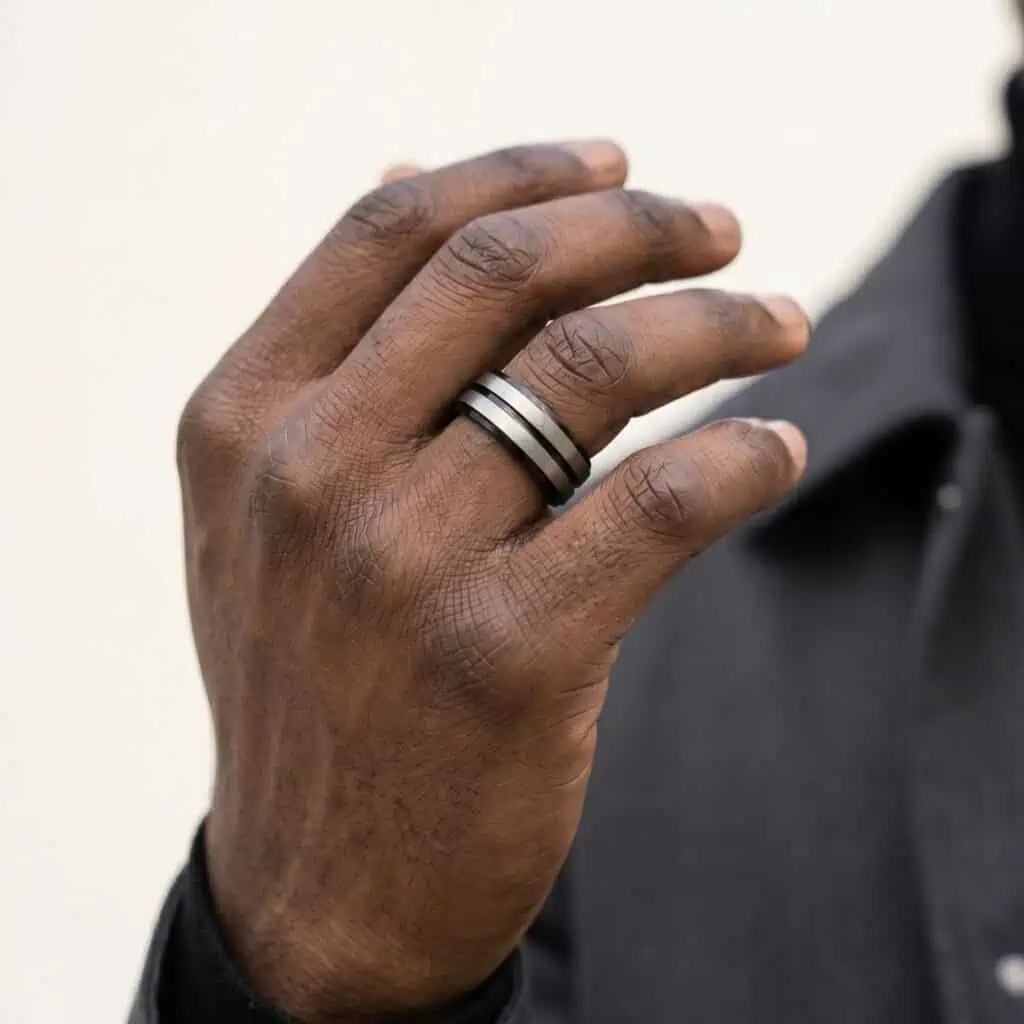
Fingers change. Our reviews give the reasons: weight lost, weight gained, a knuckle that grew with arthritis, a knuckle that was broken. When that happens to a titanium ring, the honest answer is a new ring in the right size.
That sounds worse than it is. H Samuel charges £39.95 upwards to resize a silver ring and £59.95 upwards for 9ct gold. Our men’s titanium rings start from £48. In Alan’s words:
“You would need to get a new ring, but it is still far cheaper than purchasing a silver ring and getting that resized, and you get a new ring.”
If you want to keep the original for sentiment, keep it. The replacement does the daily wear.
Getting the size right first time
The best way to avoid all of this is to measure properly before you order. Three things worth knowing:
- The knuckle decides the minimum size. In Alan’s words, you want the ring to just fit over the knuckle. That is the smallest size you can get. The knuckle is usually larger than the base of the finger, but not always.
- Measure more than once, at different times. The NHS lists hot weather and staying in one position among the causes of hand swelling. In Alan’s words, fingers are larger in hot weather and smaller in cold. That is why jeweller-measured customers still exchange.
- Arthritis changes the knuckle, not the base. Versus Arthritis describes firm, knobbly swellings at the finger joints that remain even when the pain improves. A ring sized to pass that knuckle may then sit loose at the base. The knuckle still sets the minimum.
Use a sizer. About one buyer in thirteen chooses “I don’t know my ring size” at checkout. We send a ring sizer first, then the ring in the size you confirm.
If you would rather order a ring straight away, order the size you think and add a note asking for a free ring sizer.
The most common sizes. T is the best single guess for a UK man: it is the middle size across the rings we ship. Sizes S to U cover about a third of the rings we ship, and P to W nearly three-quarters. Our size chart has the full UK, US and EU conversions.
Can a titanium ring be cut off in an emergency?
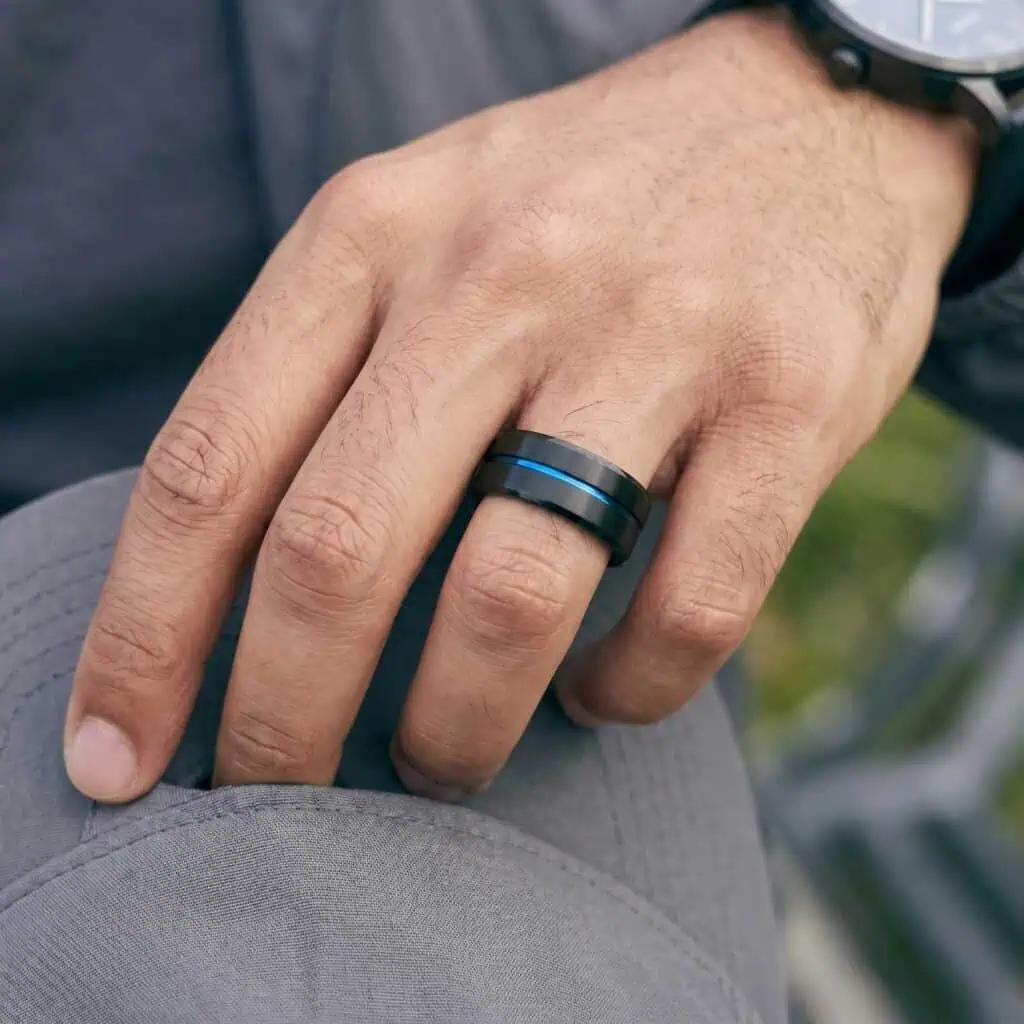
Yes. The old story that a titanium ring means amputation is false. Snopes checked it in 2008 and rated it false. What is true is that titanium needs different tools from gold.
- Gold and silver are cut with a hand ring cutter, then bent open. One cut is usually enough.
- Titanium and steel are cut with an electric ring cutter. The emergency medicine reference Life in the Fast Lane describes electric cutters for hard-metal rings. A 2013 study notes that titanium and tungsten carbide rings are exceptionally difficult or impossible to remove with standard ring cutters. Titanium does not bend open easily, so two cuts are sometimes needed.
- Tungsten carbide and ceramic are not cut with a ring cutter. A&E cracks them off with locking pliers. A 2012 cadaver study removed all six rings that way, with two cuts under a millimetre deep.
In Alan’s words: “I’ve heard about it once, but it’s very, very rare and emergency rooms can deal with them.” The practical advice is simpler. If a finger is swelling and the ring is getting tight, take the ring off before it sticks.
Sizing beads, inserts and adjusters
Several guides on this topic list them, so here is our honest view of each.
| Option | Works on titanium? | What it involves | Our view |
|---|---|---|---|
| Sizing beads | No, beads cannot be soldered on | Two small beads soldered inside the shank; beads are made of the same metal so they can be soldered | Solder cannot join titanium, so soldered beads are not an option |
| Spring insert or sleeve | Sometimes | A liner fitted inside the band; one London repairer offers sleeves for hard metals | No maker we found publishes a fit or durability figure for one on titanium |
| Clip-in plastic adjuster | Yes, loosely | A plastic coil or clip that takes up slack; metal-agnostic | Fine as a stopgap for a loose ring; not a fix |
| Wear it on another finger | Sometimes | A ring too big for the ring finger may fit the middle finger | Free, but not a fix for a wedding ring |
| Size exchange | Yes | Send it back freepost, the right size goes out the day it arrives | Our answer, for as long as the ring is not engraved |
| New ring | Yes | A fresh ring in the new size | Our answer after the 100 days |
How titanium compares
| Gold or silver | Titanium (ours, Grade 5) | Tungsten carbide | Silicone | |
|---|---|---|---|---|
| Can a jeweller resize it? | Yes, cut and solder | No | No | No, but it flexes |
| Can a specialist maker adjust it? | Yes | Plain Grade 2 by a limited amount; Grade 5 only by skimming the bore, which strips a coating | No | No |
| If the size is wrong | Resize; chains list precious metals from about £35 | Free exchange | Free exchange | Free exchange |
| Emergency removal | Hand cutter, one cut | Electric cutter, sometimes two cuts | Cracked with locking pliers | — |
| Coated or inlaid versions | — | Coated: no. Inlaid: bore-out or a small compression, by the maker | Cannot be resized | — |
Titanium and tungsten sit in the same “no” column, for different reasons. Tungsten carbide is sintered and cannot deform. Titanium could deform, but it cannot be joined at a bench, and Grade 5 is too strong and springy to hold a new size.
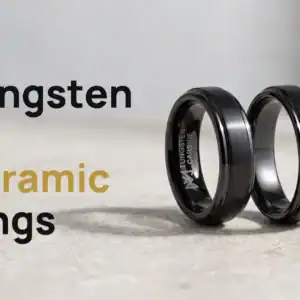
Our guide to whether tungsten rings can be resized covers the tungsten side.
Alan's verdict
“No, you can’t resize titanium or tungsten rings. That’s why we offer 100-day free returns and exchanges. Just don’t get it engraved first.”
Our men’s titanium rings start from £48, come with free unlimited size exchanges on unengraved rings, and a free sizer if you ask for one.

What Our Customers Say
Three customers on the two things this guide is about: what happens when a ring stops fitting, and what an exchange is actually like.
“He always fancied something different as a wedding ring and after he gained weight and his ring didn't fit, I bought this to replace as a 50th wedding anniversary gift. He loves it. Really good quality. Thank you. Fits a treat.”
Kay Wyatt, Cardiff
verified customer review — quoted word-for-word
“We bought it to replace my husbands wedding ring as it couldn't be resized after some weight loss and honestly we're thrilled with the quality, it feels just as expensive as the original ring he paid 3x the price for! Very pleased”
Connor Moore, Ballymena
verified customer review — quoted word-for-word
“Great wedding band from Newman Bands. Our ring was a little too big and Clare swapped it so easily. If I get married again (haha) I would come back!”
James Poulson
verified customer review — quoted word-for-word
Frequently Asked Questions
Can a titanium ring be made bigger?
Not by cutting and adding metal, because solder does not join titanium. A few specialist makers stretch or bore out their own plain commercially pure bands by a limited amount. Grade 5 will not stretch; a maker can only skim its bore slightly, which strips a PVD finish. Our rings cannot be made bigger.
Can a titanium ring be made smaller?
Not by a high-street jeweller. Compressing a band needs specialist equipment and only works on commercially pure titanium. It damages a coating or a patterned surface. For a Grade 5 ring the answer is an exchange or a new ring.
How much does it cost to resize a titanium ring in the UK?
The chains we checked do not list titanium at all. For precious metals, H Samuel charges £39.95 upwards for silver and £59.95 upwards for 9ct gold. A new titanium ring from us starts from £48.
Can a titanium ring be cut off in an emergency?
Yes. Emergency departments cut titanium rings with a powered ring cutter, sometimes in two places. The story that a titanium ring means losing the finger was rated false by Snopes in 2008.
Which rings cannot be resized at all?
Any PVD-coated titanium ring, ours included, plus tungsten carbide and ceramic. Inlaid and stone-set titanium rings are limited to a small adjustment by their maker. Silicone rings are not resized either, but they stretch to fit.
Can I resize a titanium ring at home?
No. Grade 5 titanium has a proof stress above 800 MPa and springs back when forced. If the ring does not fit, exchange it.
Does Newman Bands resize rings?
No. We exchange any unengraved ring for another size, free and as many times as it takes, and every unengraved ring has 100-day free returns. Engraved rings cannot be exchanged, so engrave only once the fit is confirmed.
Related Guides
Related: can tungsten rings be resized?
Related: are titanium rings good?
Honest list: titanium ring pros and cons
Sizing: men’s ring size chart
Sizing: free ring sizer
Buy Men's Rings
Related guides
Why choose Newmanbands
- 15,000+ verified 5-star reviews
- Free 1-2 day UK delivery
- 100-day free returns
- Every size held in UK stock
- Free ring sizer sent on request
- Personalised engraving