

Which Finger Should You Wear a Ring On? Men's Ring Finger Guide

Written by Alan MacLachlan, Owner, Newman Bands (Horsham, West Sussex)
Alan has overseen more than 100,000 ring orders since founding Newman Bands with Clare. Newman Bands is the trading name of Manzora Ltd, incorporated in 2001; it has sold men’s rings since 2019, with every design and size held in stock in the UK and same-day dispatch on orders before 5pm — most orders arrive within one to two days. Alan personally answers customer queries on metal selection and ring choice every week. Newman Bands has more than 15,000 verified customer reviews — rated 4.99 out of 5 on Reviews.io and 5.0 on Trustpilot.
Men can wear rings on any finger. There are no rules, only conventions worth knowing. This guide explains what each finger signals in UK culture, how conventions differ globally, and how to choose the right placement for any ring.
Newman Bands has helped over 100,000 customers choose rings from Horsham, West Sussex. Ring placement questions are among the most common we receive across our men’s rings range — particularly from men buying their first ring.
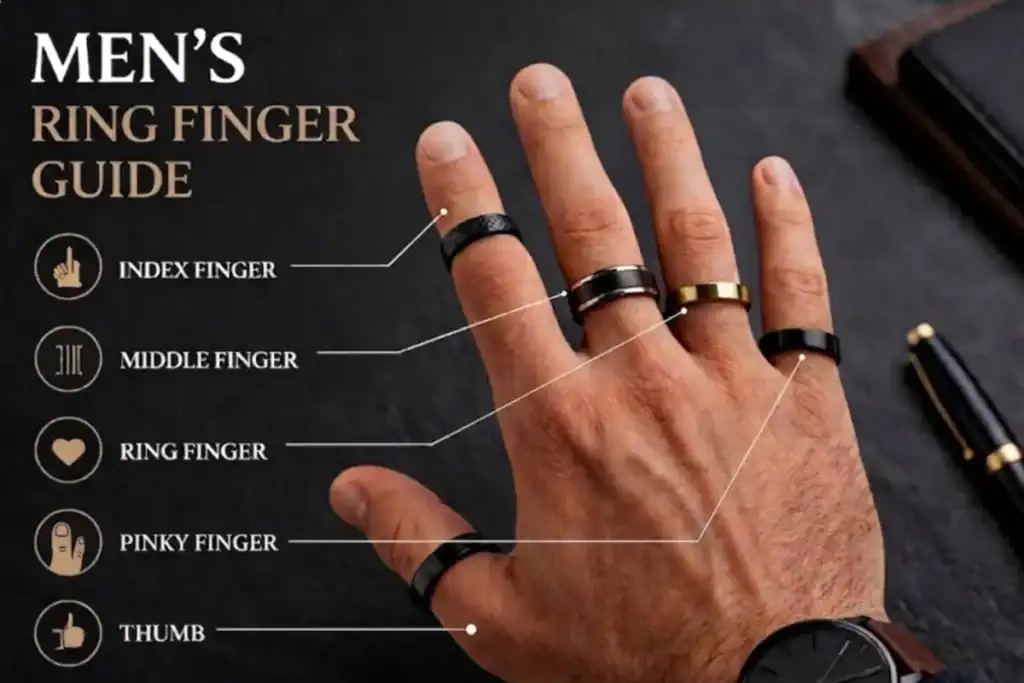
The short answer: left ring finger for wedding rings, left pinky for signet and pinky rings, everywhere else is personal preference.
In this guide
Which Finger for Which Ring?
Men most commonly wear wedding rings on the left ring finger (UK), signet rings on the left pinky, and statement rings on the index or middle finger. There are no binding rules — the meaning and look matter most.
| Finger | Common Use (UK) | Ring Types | Notes |
|---|---|---|---|
| Left ring finger | Wedding / engagement ring | Plain bands, engraved rings | Universal UK wedding convention |
| Left pinky | Signet ring | Signet, engraved | Traditional British upper-class convention |
| Right ring finger | Fashion / commitment ring | Statement bands | Avoids married signal — suits single men who want to wear a ring |
| Right pinky | Style ring | Pinky rings | No negative connotation in UK culture |
| Middle finger | Statement ring | Chunky bands | No major cultural weight — versatile |
| Index finger | Authority / fashion | Bold bands | Confident choice; historically worn by royalty |
| Thumb | Modern fashion | Wide bands | No convention — purely modern style |
No finger choice is wrong. The table above reflects conventions, not rules. The ring you want to wear determines which finger suits it best — not the other way round.
The Left Ring Finger — The Wedding Ring Position
In the UK, men wear wedding rings on the left ring finger — the fourth finger counting from the thumb. This convention comes from the ancient Roman belief in the vena amoris (vein of love) running directly to the heart. Modern anatomy disproves this, but the tradition is firmly established.
The vena amoris myth: Roman physicians believed a vein ran from the left ring finger directly to the heart — the vena amoris. Anatomy has since shown that no such specific vein exists. But the tradition outlasted the science, and left ring finger remains the UK standard for wedding rings.
Stacking rings: Some men choose to wear both an engagement ring and wedding ring on the same finger. A slim 4mm band pairs well with a second ring; anything wider benefits from its own finger.
Related: how ring size is measured
The Right Ring Finger — Style, Not Status
A ring on the right ring finger carries no standard meaning in the UK. It is typically a fashion or style choice, and signals that the wearer is not married. This makes it an excellent choice for men who want to wear a quality ring without any wedding ring association.
Cultural variation: In Germany, Russia, Norway, and some Eastern European countries, the wedding ring is worn on the right ring finger, not the left. Greek Orthodox tradition also uses the right hand. For British men, these cultural conventions are worth knowing if you travel frequently.
Fashion choice: Among Newman Bands’ customers, men buying rings for style rather than wedding purposes frequently choose the right hand for this reason. A clean tungsten or titanium band on the right ring finger reads as intentional — not accidental.
The black ring signal. A plain black ring on the right ring finger is sometimes used as a discreet signal within open-relationship communities. It is a self-selecting minority use with no formal organisation behind it — the overwhelming majority of right-hand rings are worn for style or cultural tradition. For the full context, see our guide: What Does a Black Ring on the Ring Finger Mean?
The Middle Finger — Modern and Neutral
The middle finger carries no dominant cultural meaning in the UK — it is the most neutral finger for a statement ring. It is centrally positioned on the hand, making any ring worn there visually prominent. A well-chosen band on the middle finger is one of the more confident style choices a man can make.
Bands under 8mm wide work best on the middle finger for all-day comfort. Very wide rings restrict movement on this finger more than others. A 6mm flat band in tungsten or titanium is a versatile and practical choice.
The right middle finger is the exception. A plain black ring worn on the right middle finger is the recognised symbol of the asexual community, a convention associated with AVEN (the Asexual Visibility and Education Network), and the most consistently recognised asexual ring placement. Outside that community context the right middle finger carries no established meaning in the UK.
For the full context on the asexual ring convention, see our dedicated guide: our guide to the asexual ring meaning
The Index Finger — Traditional Authority
Historically the index finger was the ring finger of authority — kings, bishops, and nobles wore signet rings here. Today it is a bold, confident choice. Class rings (common in North America) also sit on the index finger. It is the most visible of the non-traditional ring fingers.
The index finger moves constantly during daily tasks. Rings without sharp edges work better here than high-profile or ridged designs. A smooth, low-profile band in tungsten or titanium wears comfortably on the index finger without catching or snagging.
The Pinky — The Signet Ring Tradition
In British tradition, the left pinky is the conventional signet ring finger. This dates back centuries and remains the standard in formal and professional UK circles. A slim band on the pinky — 4mm to 6mm wide — sits naturally without overwhelming the finger.
Signet rings: A signet ring features a flat engraved face — traditionally a family crest or monogram. The left pinky has been the standard placement for British signet rings for generations.
Professional rings: Certain professions mark milestones with a ring worn on the little finger — a tradition found in engineering and law in various countries. This is uncommon in standard UK practice but is recognised in some specialist fields.
Ring width for the pinky: The little finger is narrow. A ring wider than 6mm typically looks disproportionate. A 4mm flat band or slim signet is the most comfortable all-day choice.
The Thumb — Modern, and Unclaimed by Tradition
Thumb rings carry no established cultural or symbolic meaning for men in the UK. In some ancient and cross-cultural contexts a thumb ring indicated wealth, status or self-assertion, but none of those readings survive in modern British usage. That makes the thumb the freest placement on the hand — a purely style-led choice, and an effective one for wide, bold bands that would overwhelm a narrower finger. Thumbs also take a noticeably larger size than the fingers on the same hand, so measure the thumb directly rather than estimating from a ring finger.
“This ring looks fantastic, I am wearing it at as a thumb ring and it's very comfortable and well made.”
Aaron Howard, Kilbirnie
verified customer review — quoted word-for-word
UK Traditions vs Other Countries
Wedding ring hand conventions vary across cultures. In the UK, left ring finger is standard. In Germany, Russia, and Norway, the right ring finger is used. In India, the convention varies by religion and region. In Spain and Greece, right hand is common. There is no universal rule.
| Country / Tradition | Wedding Ring Hand | Notes |
|---|---|---|
| UK (England, Wales, Scotland) | Left ring finger | Near-universal convention |
| Germany | Right ring finger | Standard German tradition |
| Russia | Right ring finger | Orthodox Christian tradition |
| Norway | Right ring finger | Scandinavian convention |
| India | Varies by religion / region | Hindu tradition: right hand; varies widely |
| Spain | Right ring finger | Common in Catholic tradition |
| Greece | Right ring finger | Greek Orthodox tradition |
| Ireland | Left ring finger | Same as UK convention |
For British men, this global variation is worth knowing if you have a multicultural wedding or a partner from another cultural tradition. There is no obligation to follow UK convention if another placement is more meaningful.
Religious and Cultural Traditions
Ring placement varies meaningfully across religious traditions. Knowing these avoids misreading what a ring means when the cultural context is not the UK default.
Islam. Silver rings are permitted for men in Islamic tradition; gold is forbidden for men, though permitted for women. Muslim men who wear rings typically wear them on the right hand, with the right index and right ring finger both accepted. There is no single fixed rule across all schools of Islamic jurisprudence.
Orthodox Christianity. In Orthodox Christian tradition the wedding ring is worn on the right hand, which is why a wedding band sits on the right in Greece, Russia, Serbia and Romania. Right-hand wedding rings are also standard in Germany, Poland and Austria — though there the custom is Catholic and Lutheran in origin rather than Orthodox.
Jewish tradition. In a traditional Ashkenazi Jewish ceremony the ring is placed on the bride’s right index finger. After the ceremony it is usually moved to the left ring finger. The right index placement is a specific ritual act, not a permanent wearing convention.
Hindu tradition. The right hand is generally the auspicious hand for ceremonial actions, and wedding rings, where worn, are sometimes placed on the right. Men’s ring-wearing conventions vary considerably across South Asian communities and are less standardised than Western ones.
The principle worth holding on to: in the UK default, the left ring finger means marriage. Every other placement is either a fashion choice or a culturally specific tradition — so never read meaning into a ring without knowing the wearer’s context.
Choosing a Finger for a Fashion Ring
For a ring with no ceremonial purpose, the only real rule is that it should look and feel right on the hand wearing it. A few things reliably hold:
Bold and statement rings. Index finger and thumb are the strongest placements — both are prominent in gesture and movement, so wide bands read as deliberate rather than oversized.
Slim stacking rings. Ring, middle and index fingers all suit stacking. The interest comes from variety across the hand rather than one strong placement.
Signet-style rings. Pinky or index. The pinky reads traditional; the index is bolder and more contemporary.
Wide bands. Ring and middle fingers carry width best. Wide rings on a pinky tend to look crowded and sit less comfortably.
“Got this for my husband's pinky finger,modern, smart and elegant, something different to a signet ring, I'm so pleased I did . Husband loves it too.”
Lydia Howlett, Southampton
verified customer review — quoted word-for-word
Frequently Asked Questions
Which finger should a man wear a ring on?
Any finger — but left ring finger for wedding rings in UK tradition. Signet rings go on the left pinky. Fashion and style rings suit the right hand, middle finger, or index finger. There are no mandatory rules beyond personal preference.
What does a ring on the right hand mean for a man?
In the UK, a ring on the right hand typically signals a fashion or personal choice rather than married status. In some European countries — Germany, Russia, Norway, Greece — the right hand is where wedding rings are worn. For British men, right-hand rings carry no fixed meaning.
What does a ring on the middle finger mean for a man?
No dominant cultural meaning in the UK. The middle finger is the most neutral choice for a statement or fashion ring. It sits centrally on the hand and makes any ring visually prominent without a specific social signal.
Should a man wear a signet ring on his pinky?
In British tradition, yes — the left pinky is the conventional signet ring finger. A slim 4mm–6mm band or a flat-face signet sits naturally on the little finger. Right pinky is also acceptable for modern fashion rings with no negative connotation.
Related: the men’s ring size chart
Related: the men’s pinky ring guide
Related: do rings look good on men?
Related Guides
Not sure of your size? Order a free ring sizer
Buy Men's Rings




Related guides





Why choose Newmanbands
- 15,000+ verified reviews — 4.99★ Reviews.io, 5.0 Trustpilot
- Free 1-2 day UK delivery
- 100-day free returns
- Every size held in UK stock
- Free ring sizer sent on request
- Personalised engraving